
It is Monday morning. A procurement manager at a mid-sized manufacturer opens 14 new purchase requests, three RFQs closing this week and a pile of supplier invoices that do not match their orders. AI can now draft, read and compare most of that. The harder question is what she should do with the hours it saves. The pressure behind that question is real: McKinsey's benchmarking shows that spend managed per procurement employee is 50% higher than five years ago.
Yet the gains often stay with individuals. A Gartner survey of 101 chief procurement officers found that generative AI makes people faster, but the benefit fades at team level. Gartner calls this the AI productivity paradox, and the cause is usually the same: AI gets added to old jobs instead of being built into the process.
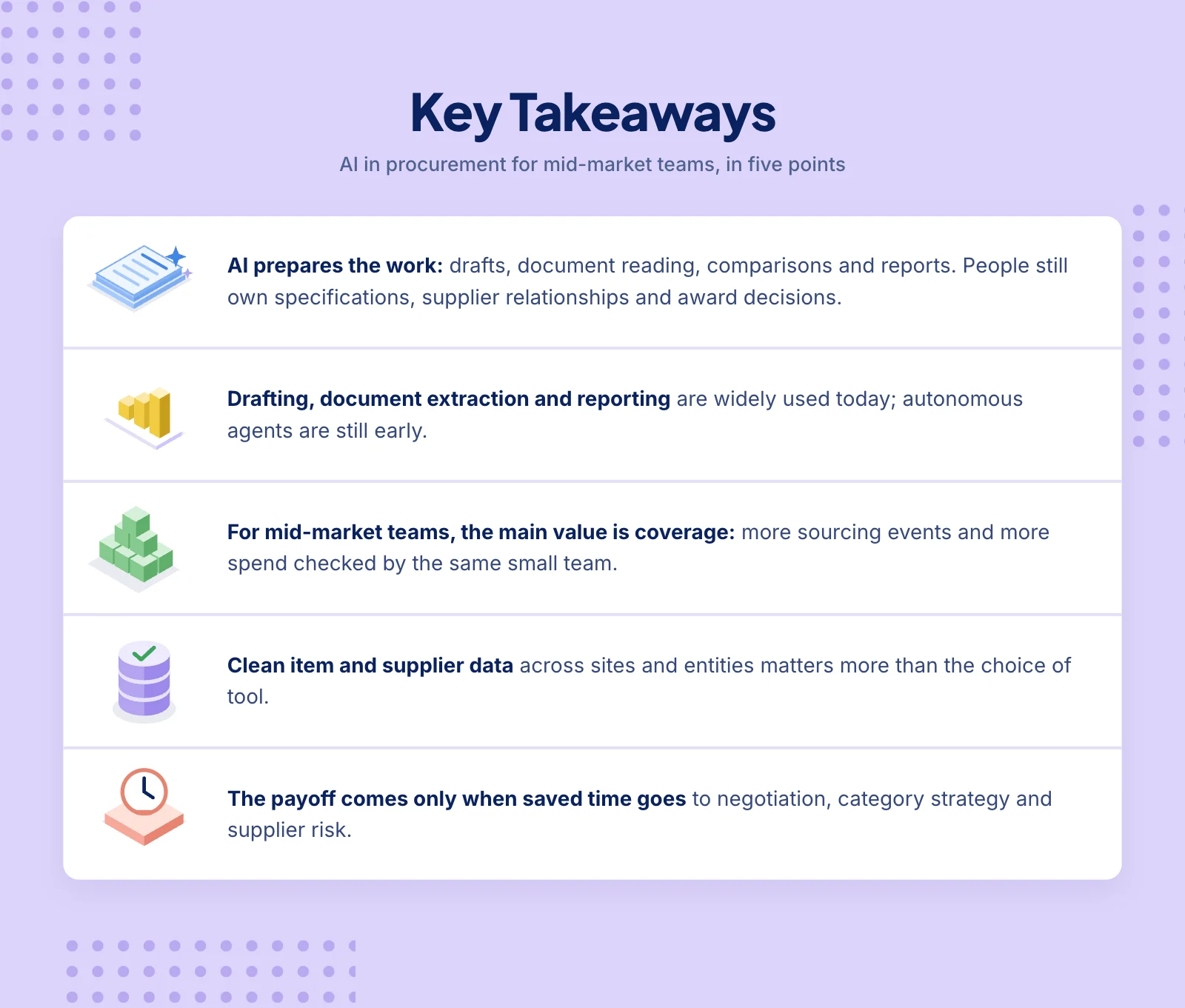
This guide is written for mid-market procurement teams: a few people covering many categories, often across several sites or legal entities, without the data science teams and transformation budgets of large enterprises. It covers where AI in procurement helps, where it fails, how to build it into each stage of sourcing and buying, how to judge AI tools, and what procurement managers should do with the time AI frees up. The short version: AI prepares, the specialist decides.
What is AI in procurement?
AI in procurement is the use of machine learning and generative AI to read, draft, compare and summarize the information that sourcing and purchasing run on: requests, specifications, supplier responses, contracts, orders and invoices.
It differs from older procurement automation in one important way. Rule-based automation follows fixed instructions, such as routing every purchase order above a set amount to a finance approver. AI works with unstructured content. It can turn a two-paragraph brief into a draft request for quotation, read a supplier's PDF quote, or answer a question about last quarter's spend in plain language. If you need a refresher on the document types involved, see our guide to RFI vs RFP vs RFQ.
That flexibility is also why AI needs oversight. A rule either fires or it doesn't. An AI output can look complete and still be wrong.
Procurement AI is already mainstream. In a McKinsey survey of more than 300 procurement leaders, 40% said their function had implemented or piloted generative AI.
How is AI used in procurement and sourcing today?
AI in sourcing and procurement is used today mainly to prepare work for people: turning documents into structured data, drafting sourcing events, comparing responses and answering questions about spend. The most common use cases follow the process from request to reporting:
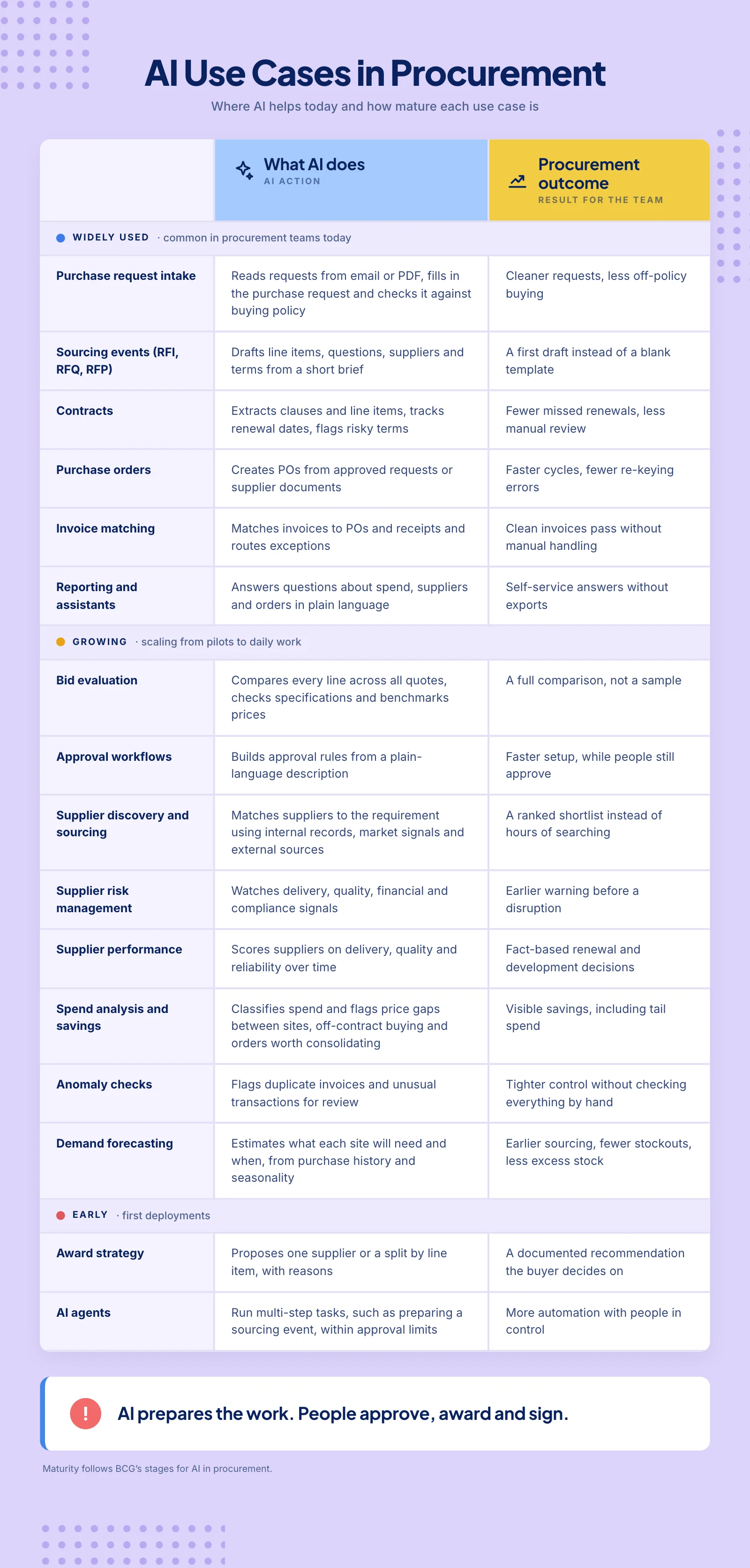
Maturity follows BCG's stages for procurement AI: generative AI in procurement is already common for drafting and reading documents, AI-driven workflows are scaling, and autonomous agents that recommend awards or run whole events are still early.
Two examples from practice. In WorkFish, a user can describe an approval process in plain language, such as "Purchase orders over $10,000 go to the finance manager, and IT purchases also need the IT lead's approval," and AI builds the approval workflow; the team checks the rules before switching them on. In a BCG case, spend analysis showed that about half of a hospital system's spend on identical items varied by roughly 5% in price between sites.
McKinsey lists RFx generation and analytics, category copilots, contract optimization and invoice-to-contract compliance among the AI solutions procurement teams can adopt now, without multiyear IT programs. Across all of these AI use cases in procurement, the output is a draft or a recommendation that a person reviews.
What changes for mid-market procurement teams?
Most published AI results, including the McKinsey and BCG cases in this guide, come from large enterprises with big category teams and multi-year budgets. Mid-market companies work differently, and that changes where AI pays off first:
- Small team, many categories. Three or four buyers often cover dozens of categories. AI's main value is coverage: running more sourcing events and checking more spend than the team could by hand, not cutting headcount.
- No data science team. Custom models are out of reach, so AI has to come built into the procurement workflow and work on the documents and records you already have.
- Data spread across systems and sites. Supplier and item records often live in an ERP, spreadsheets and email, in different versions for each site or legal entity. AI fails first on exactly these inconsistencies.
- Little room for long pilots. Start with uses where results are easy to see and check: request intake, RFQ drafting and bid comparison.
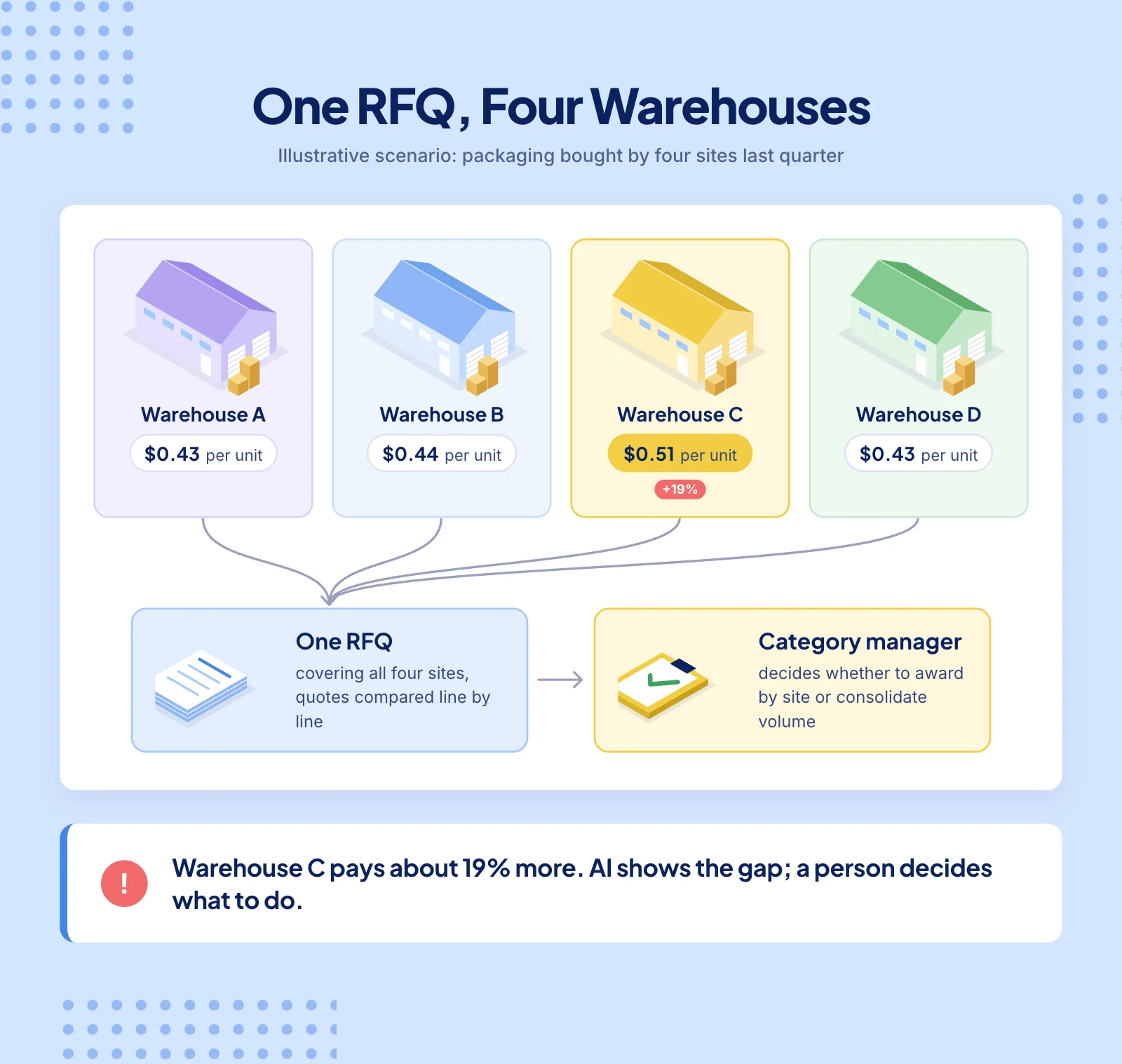
Example scenario (illustrative). A mid-sized distributor has a three-person procurement team, four warehouses and two legal entities, and buys packaging every quarter. Without a shared catalog, each site sends its own request to its own suppliers, and nobody sees that one warehouse pays more than the others. With one catalog and one supplier base, AI can draft a single event covering all four sites, compare quotes line by line and show which site paid the most last quarter. The category manager then decides whether to award by site or consolidate volume, a commercial call AI cannot make.
Where a mid-market team should start:
- Pick two or three high-volume categories and run them through AI-assisted sourcing first.
- Standardize item and supplier records across sites and entities before switching AI on more widely.
- Write approval limits per entity into the workflow, and compare prices across sites, not only within one.
What are the benefits of AI in procurement?
The benefits of AI in procurement go beyond saved time. They show up in five places:
- Speed. Requests, sourcing events and comparisons start as prepared drafts, so the time from need to purchase order shrinks.
- Cost. Every quote line and every transaction gets checked, so price gaps, off-contract buying and consolidation options surface. Savings are measured against a baseline agreed with finance: the last price paid, the budget or the first quote.
- Control. Approval rules, access rights and the audit trail apply to AI-prepared work exactly as they do to manual work, and reviewers see the reasons behind each recommendation.
- Consistency across sites. With one catalog, one supplier record and one set of rules for every site and entity, AI compares like with like.
- Team capacity. Time moves from re-keying and chasing documents to negotiation, supplier development and category strategy.
The size of the gain is still an estimate. McKinsey's analysis suggests AI could make procurement functions 25 to 40 percent more efficient. Deloitte's 2025 CPO survey found that the top digital performers report an average 3.2x return on generative AI investments, compared with slightly above 1.5x for other organizations. Both figures describe leaders with mature data and processes, which is what the rest of this guide is about.
What are the risks and limits of AI in procurement?
The biggest risk of AI in procurement is a confident wrong answer that nobody checks. Generative AI produces text that reads well even when a number, a clause or a specification is missing or invented. Other limits to plan for:
- Bad data in, bad output out. If supplier records are duplicated or item names are inconsistent, AI matches the wrong item or the wrong supplier.
- Confidential pricing. Supplier quotes are commercially sensitive. An AI tool must show each user only what that user is allowed to see, and must not undermine the rules of a sealed RFQ.
- Data handling. Documents and prompts may be processed by an outside AI model. Ask where your data goes and whether it is used to train the vendor's models; supplier pricing and contract terms should stay under your control.
- Bids that are not comparable. AI can line up two quotes that look equal while one excludes freight or uses a different unit of measure.
- Accountability. A supplier, an auditor or your finance lead will ask who chose the winner and why. "The AI recommended it" is not an answer.
- Skill erosion. If junior buyers only approve AI output, they may never learn to build a specification or read a supplier's cost structure.
- Organizational barriers. In Deloitte's survey, CPOs ranked siloed ways of working (57%) and talent gaps (34%) among the top barriers to delivering value.
Example: two bids that look the same (illustrative figures). Supplier B looks cheaper per unit, but its quote excludes freight. Once delivery is added, the ranking flips.
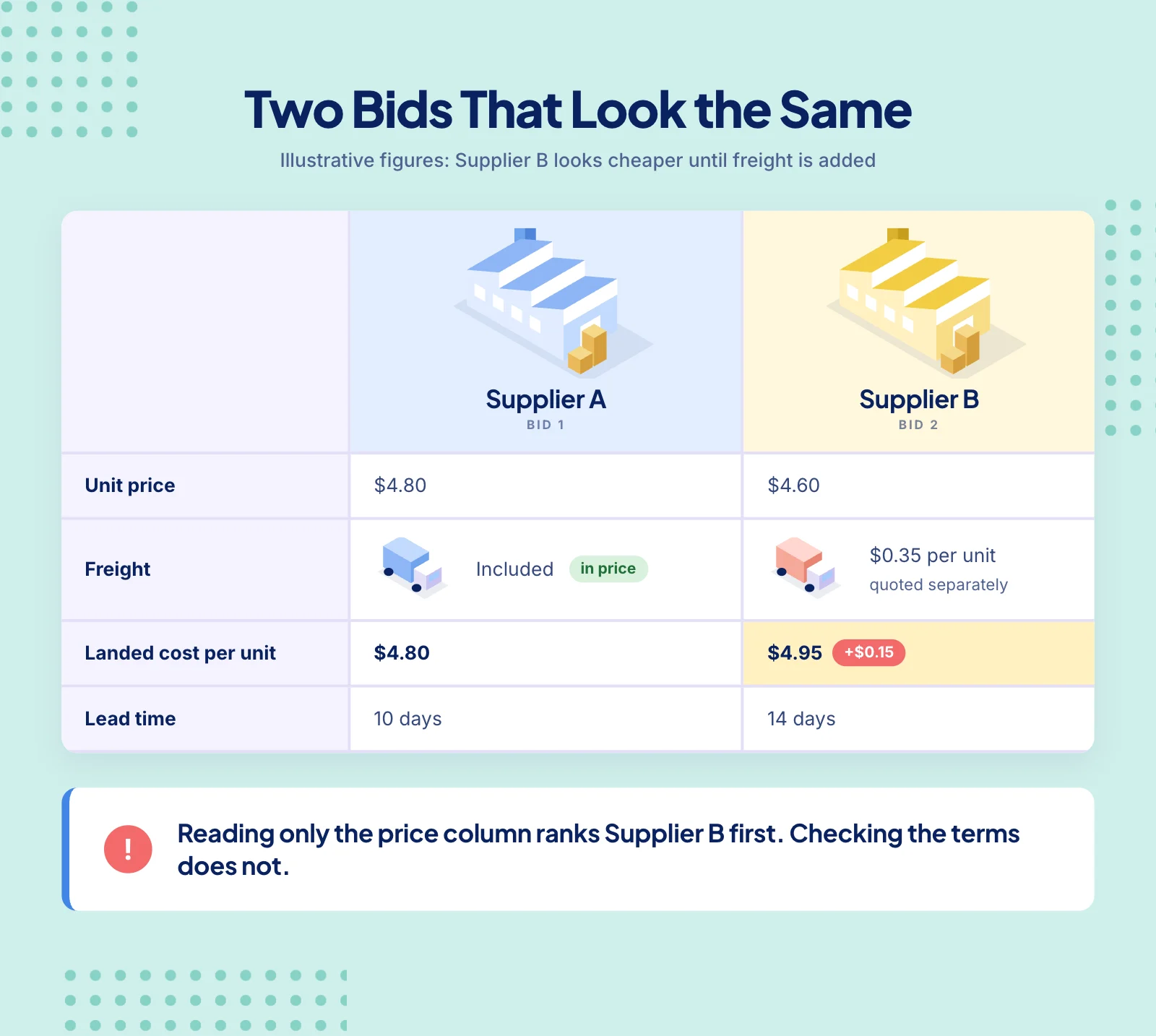
A comparison that reads only the price column ranks Supplier B first. A buyer who checks the terms does not.
None of these is a reason to avoid AI. They are reasons to define, in advance, where AI drafts and where a person decides.
How do you build AI into your procurement process?
To build AI into procurement, decide stage by stage what AI prepares and what a person decides, then fix the data and controls that make AI output reliable. The tool matters less than the setup: BCG estimates that about 70% of an AI transformation's success depends on people, organization and processes, 20% on technology and 10% on algorithms.
Where AI fits at each stage of procurement
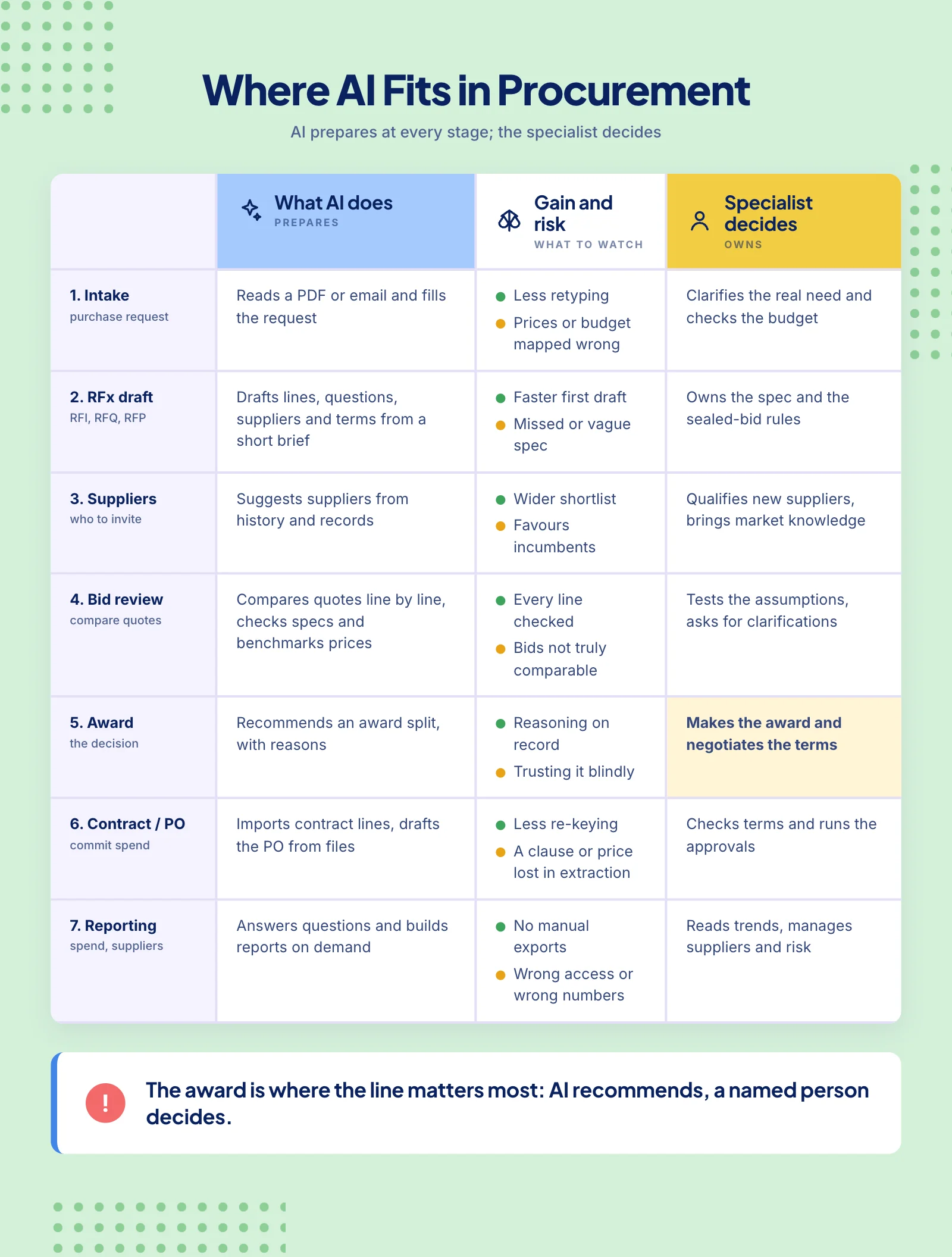
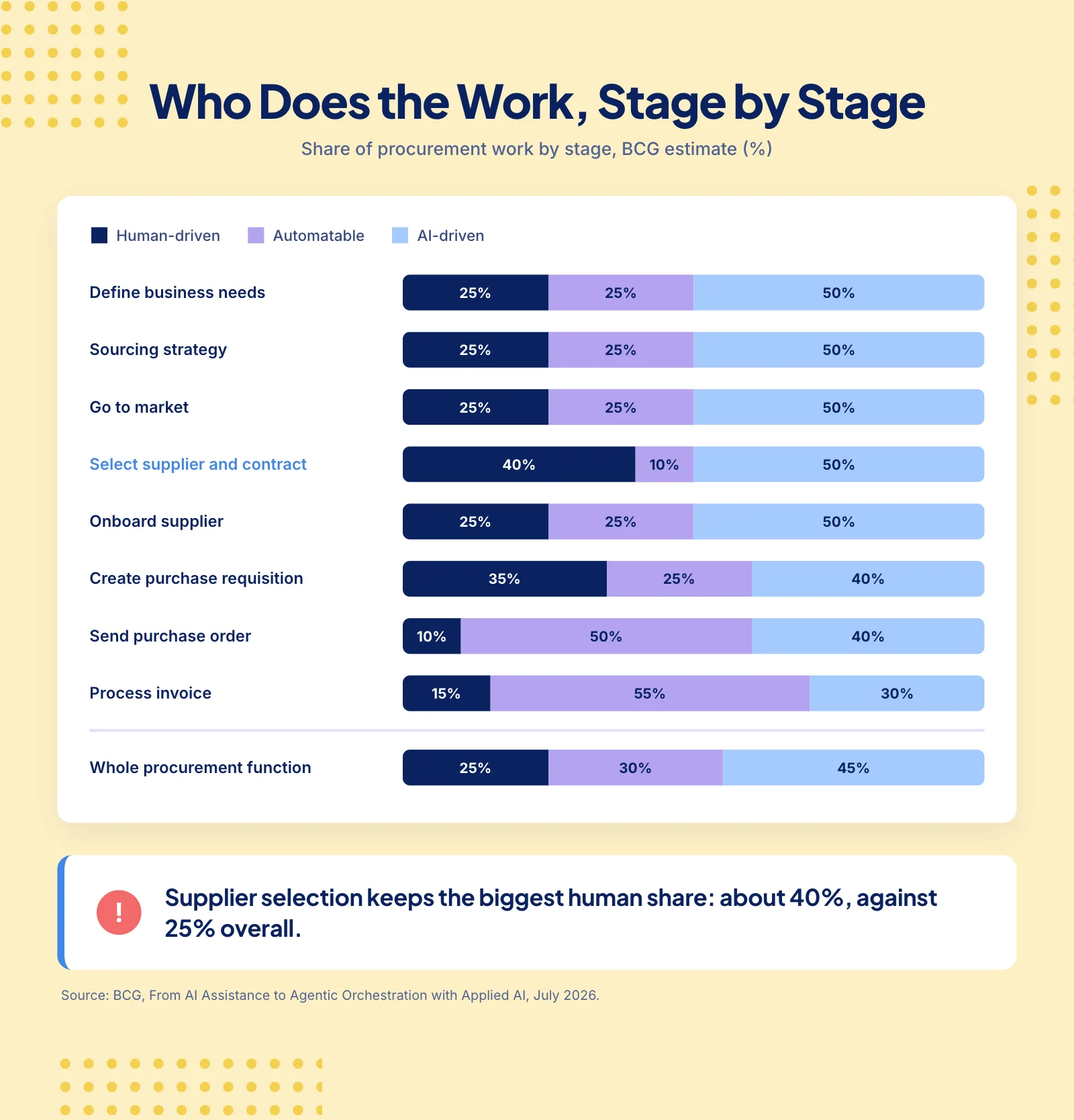
The pattern repeats at every stage: AI handles reading, drafting and comparing, while the specialist owns the specification, the supplier relationship and the decision. The award stage is where that line matters most. BCG's analysis reaches a similar split: for supplier selection and contracting, it estimates that about 40% of the work stays human-driven, compared with around 25% across the procurement function as a whole. Some uses run across all seven stages rather than inside one: supplier risk monitoring, spend analysis, demand forecasting and approval workflows.
See it in practice: book a WorkFish demo to watch Enigma draft an RFQ and compare quotes while your buyer makes the award.
Seven steps to put this into practice
- Split tasks between AI and people. Gartner recommends reviewing each procurement role and separating innately human tasks from AI-native ones. Make that split explicit for every stage above.
- Fix the data first. Item catalog, supplier records, purchase history and contracts should live in one system. McKinsey estimates that procurement functions use less than 20 percent of the data available to them to support decisions. A disconnected procurement workflow is usually the reason.
- Start where output is easy to check. Drafting requests and extracting data from documents are good first steps, because a reviewer can spot errors quickly.
- Set control points. Every AI draft is reviewed before it is applied. Award decisions stay with a named person. Existing approval workflows do not change because AI was involved. Name one person per category who owns the quality of AI output.
- Control access. AI should see and show only what each user is allowed to see, especially supplier pricing and financial data.
- Measure the right things. Track time to first draft, how much reviewers change AI output and how many errors review catches, not just hours saved. Gartner also recommends updating productivity measures for AI-enabled work, and BCG suggests outcome KPIs such as the share of spend actively managed, requisition-to-PO cycle time and AI adoption by team.
- Update roles and skills. Write down what changes in each job, and train people to review AI output rather than simply accept it.
Questions to ask any AI procurement vendor
Most procurement platforms now claim AI. Five questions separate working features from marketing:
- What is live today? Ask for a demo on your own documents, not a prepared dataset, and a list of features that are still on the roadmap.
- Who sees what? Check that AI shows each user only what their role allows, and ask where data is processed and whether it trains the vendor's models.
- Can people review every output? Each AI draft or recommendation should be editable before it is applied, with a log of who approved it.
- Does it handle your structure? Test several entities, currencies and sites in one scenario.
- What happens when AI is wrong? Ask how users flag errors and how quickly they are fixed.
If AI saves procurement managers time, what should they focus on?
When AI takes over drafting and comparison, procurement managers should reinvest the time in work AI cannot do: judgment, relationships and strategy. That shift does not happen by itself. Gartner found that 63% of senior procurement leaders expect AI to significantly improve performance within three years, yet only 25% of procurement leaders have redesigned jobs as a result of AI. Without a plan, time saved by individuals disappears into more of the same work.
McKinsey describes the target split clearly: people take on creative problem solving, relationship building and complex judgment, while AI agents handle scale, speed and synthesis. In practice, that means five areas of focus:
- Supplier relationships and negotiation. Use AI to prepare, then spend the time with the supplier. In a McKinsey example, a telecom company's AI agents built the negotiation fact base and drafted counteroffers; the team's analysis and email time fell by up to 90%, and negotiations delivered 10–15% savings across vendors.
- Category strategy and market knowledge. Understand what drives cost in each category, where alternative sources are and where the market is moving.
- Risk and resilience. Qualify new suppliers, keep alternative sources active and watch single-source dependencies.
- Quality control of AI output. Test the assumptions behind a recommendation, spot bids that are not truly comparable and ask suppliers to clarify.
- Internal customers. Understand the real need before a request becomes a specification. A clear need saves more money than any AI draft.
BCG describes the same shift as a set of new roles: a negotiator who designs and oversees negotiation workflows, a category and value strategist, an AI performance manager who validates AI output and manages exceptions, and a market intelligence integrator who checks AI insights for business relevance. In a mid-sized team, one person often covers several of these roles.
This is the future of AI in procurement in practical terms: fewer hours spent assembling documents, more hours spent on decisions that carry commercial weight.
How does WorkFish use AI in procurement?
WorkFish builds AI into the procurement workflow through Enigma, its AI assistant, and follows the same principle throughout: AI suggests, the user reviews and decides.
- Ask and report. Enigma answers questions about your procurement data in plain language and builds reports on request.
- Draft sourcing events. Enigma turns a written brief into a full draft RFI, RFQ or RFP: line items matched to your catalog, questions, suppliers and terms. It asks clarifying questions where it is unsure, and the buyer reviews every proposal before applying it.
- Evaluate responses. For RFIs, Enigma suggests scores, brings in each supplier's history and recommends a shortlist. For RFQs, it compares quotes line by line, checks offered products against minimum specifications, benchmarks prices against your own purchase history and recommends an award split with its reasons. The buyer makes the award.
- Build workflows from a description. Describe an approval process in plain language and WorkFish builds the workflow with AI. The team reviews the generated rules before switching them on.
- Create documents from files. Purchase requests, purchase orders, goods receipts and supplier invoices can be created from uploaded documents, and contracts can be imported and itemized for procurement contract management.
Because sourcing, contracts and orders sit in one workflow, Enigma works from connected data rather than separate spreadsheets.
Conclusion: AI prepares, the specialist decides
AI can take over the routine side of procurement, but it cannot make the commercial calls. The teams that get real value from it treat AI as a capable assistant inside a well-run process: they agree early on where its work ends and a person's begins, and they turn the hours it frees into stronger supplier relationships and sharper sourcing decisions.
See how Enigma drafts an RFQ and compares quotes while your team makes the call. Book a demo.
