
When several suppliers answer the same RFP, the evaluation team has to judge which proposal will actually deliver. Price makes that harder. Once evaluators know one bid is, say, 20% cheaper (an illustrative figure), a thin methodology can start to look “good enough” and a strong team can start to look overstaffed.
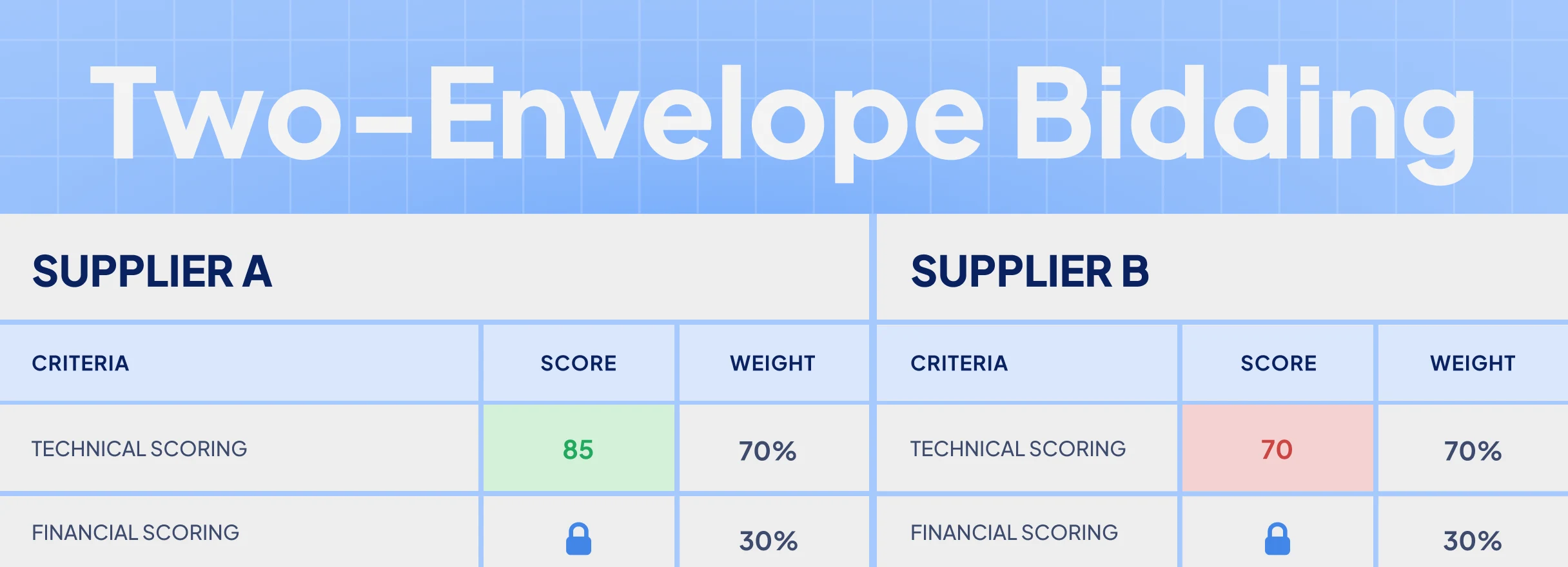
Two-envelope bidding addresses this by splitting every response into a technical proposal and a financial proposal, and by evaluating the technical side before anyone opens the price.
What Is Two-Envelope Bidding in an RFP?
Two-envelope bidding is a way to run RFP evaluation so that quality is judged before cost. RFP evaluation is the process of comparing supplier responses against criteria published in the request for proposal. In a two-envelope RFP, each supplier splits its response into two sealed parts: a technical proposal and a financial proposal.
The most common form is single-stage two-envelope bidding. Suppliers submit both envelopes once, by the same deadline. The buyer then opens them in sequence: technical envelopes first, financial envelopes later, and only for suppliers whose technical bids are found responsive. The Asian Development Bank describes exactly this order, and the EBRD notes that it lets evaluators focus on technical merit “without influence of the price.”
The name comes from paper tenders. Suppliers sealed their technical and financial proposals in two separate envelopes, enclosed in one outer envelope. In eSourcing software, two-envelope is usually a bid type you select when creating an RFP, tender, or RFQ.
You may also see the terms two-bid system or double-envelope bidding. They usually mean the same separation, but check the procedure: some organizations use them for different rules on when and how prices are opened.
What Goes in Each Envelope
The technical envelope proves the supplier can do the work; the financial envelope says what it will cost. The RFP documents define the exact split, and the one rule that matters most is that no price information appears in the technical envelope.
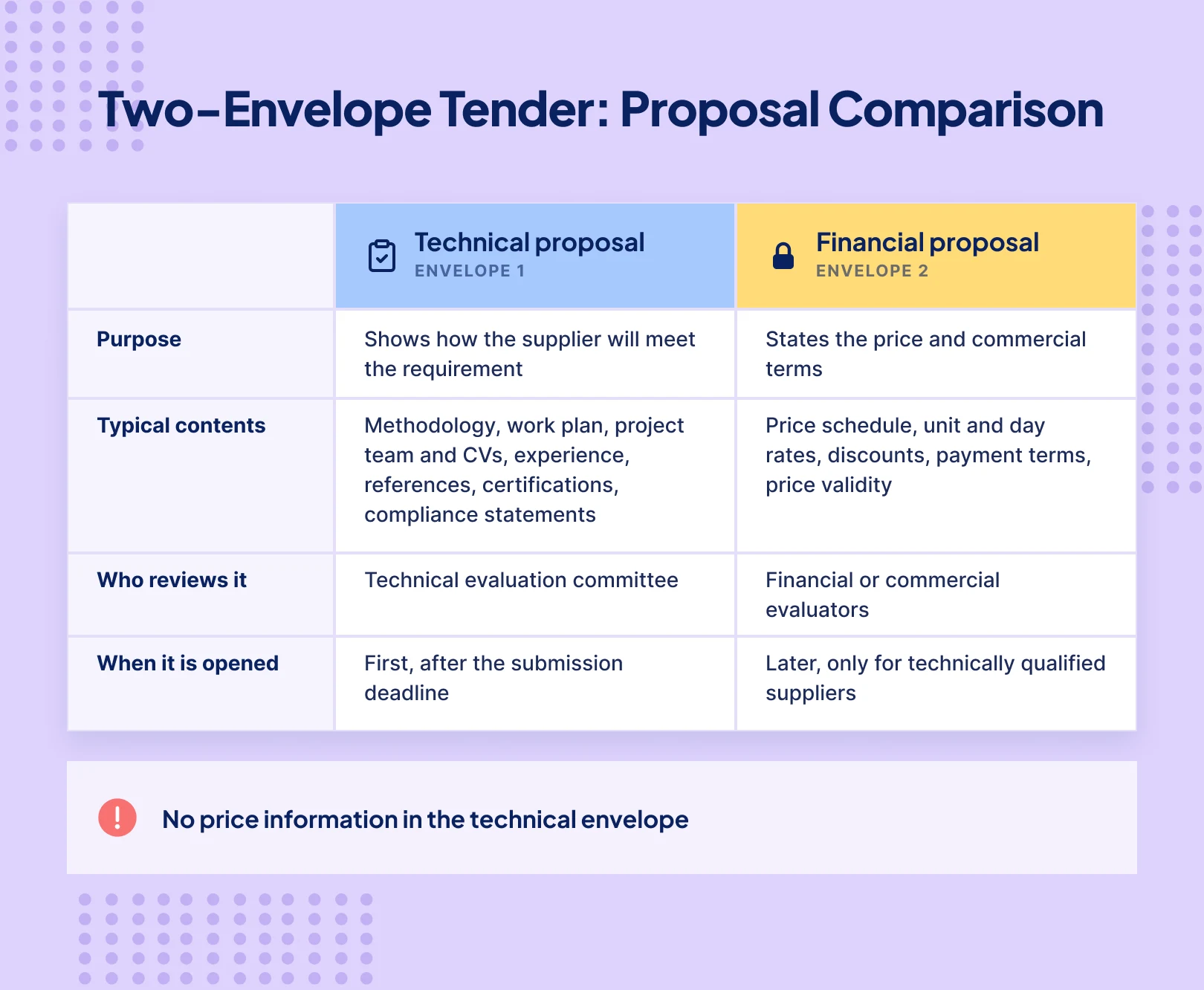
Price leaks often hide in ordinary documents: a staffing plan with day rates, a sample invoice, a license table copied from a standard proposal, or a cover letter that mentions a discount. A clear RFP lists which documents belong where and states what happens if pricing shows up in the technical envelope.
How the Two-Envelope Process Works
A single-stage two-envelope RFP runs in nine steps. The key control is that opening the financial envelopes is a separate, recorded event that happens only after the technical evaluation is finished and approved.
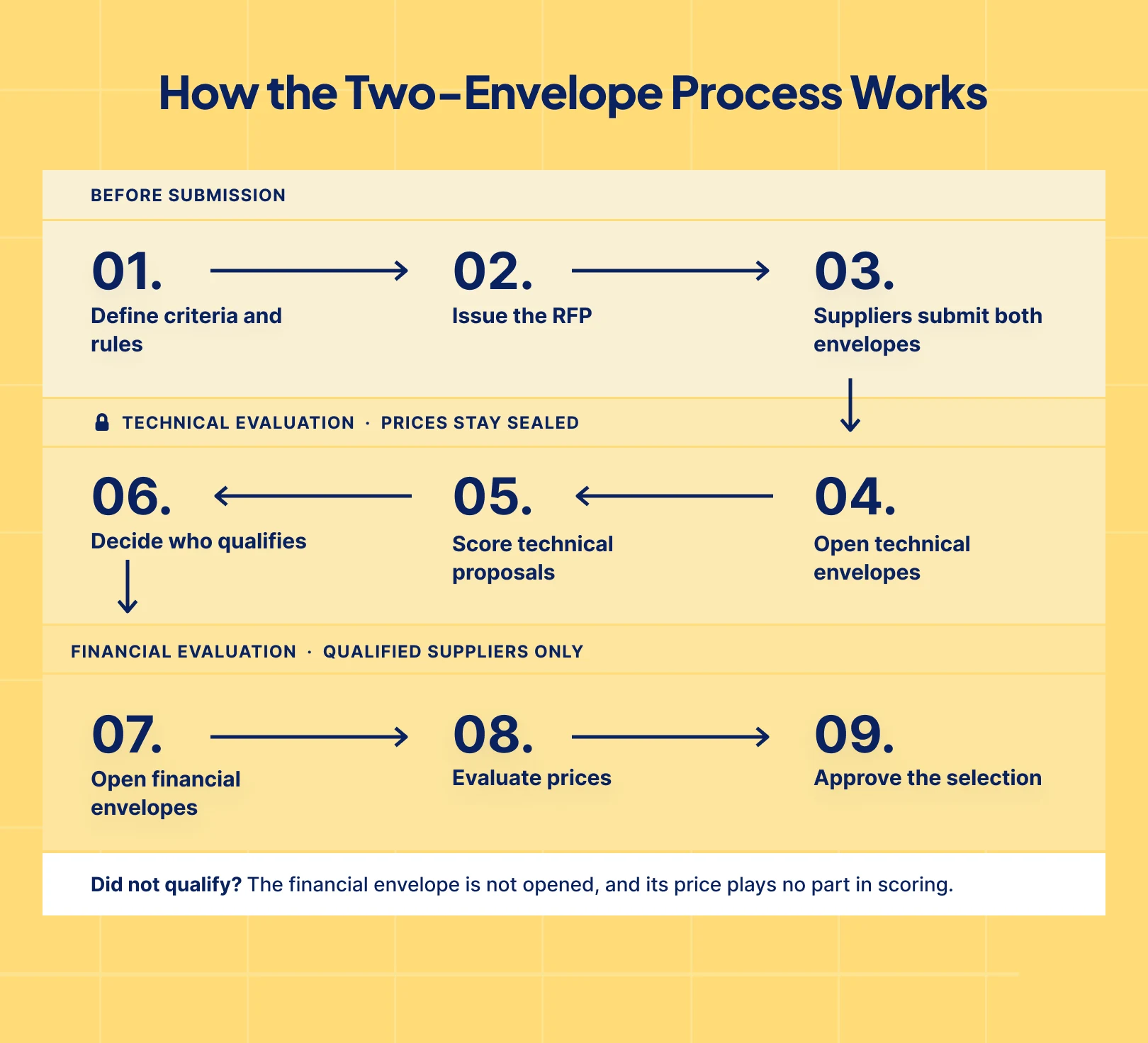
- Define the criteria and rules. Before release, the buying team sets the technical criteria and weights, any minimum technical score, the selection method, and the opening sequence. These go into the RFP.
- Issue the RFP. The invitation tells suppliers exactly what goes in each envelope, the deadline, and how proposals will be opened and evaluated.
- Suppliers submit both envelopes. Technical and financial proposals arrive together, by the same deadline, as separate sealed parts.
- Open the technical envelopes. After the deadline, the buyer opens only the technical proposals. Financial envelopes stay sealed and are held by someone outside the technical committee.
- Evaluate technical proposals. The technical committee scores each proposal against the published criteria, with no access to prices. Under ADB’s single-stage procedure, proposals cannot be changed at this point.
- Decide who qualifies. Proposals that fail mandatory requirements or the minimum score are marked non-responsive. Results are documented and, where the procedure requires it, approved by a reviewer, board, or funding agency.
- Open the financial envelopes. Only the qualified suppliers’ prices are opened. In some public procedures this opening is public; disqualified suppliers’ envelopes stay unopened.
- Evaluate prices. Financial evaluators check arithmetic, compare prices on a like-for-like basis, and apply the published scoring or selection rule.
- Approve the selection. The combined result or lowest evaluated qualified bid goes through the approval route defined in the RFP, and the decision is recorded.
Two-Envelope vs Single-Envelope vs Two-Stage Bidding
The difference is when price is submitted and when it is opened. Two-envelope and two-stage bidding both evaluate technical quality first, but two-stage bidding collects prices in a separate, later round.
| Single-envelope | Single-stage two-envelope | Two-stage | |
|---|---|---|---|
| When price is submitted | With the technical response, in one document | With the technical response, in a separate envelope | In a second round, after technical evaluation |
| Rounds of submission | One | One | Two |
| When price is opened | At the same time as everything else | After technical evaluation and approval, for qualified suppliers only | After the second-round submission |
| Changes to the technical proposal | Per RFP rules | Not allowed during evaluation (ADB) | Discussed and revised between stages |
| Typical fit | Simple, well-specified purchases | Defined requirements where quality must be judged on its own | Complex requirements the buyer cannot fully specify up front |
In two-stage bidding, as ADB describes it, suppliers first send technical proposals without prices. The buyer discusses deficiencies, and suppliers then submit prices together with revised technical proposals. Note that a sequence of RFI, RFP, and RFQ documents is a sourcing strategy, not two-stage bidding.
A sealed RFQ or sealed RFP simply means responses stay confidential until the deadline. It can be single- or two-envelope.
When to Use Two-Envelope Bidding
Use two envelopes when the technical solution matters as much as the price and suppliers can propose different ways to meet the need. Typical cases:
- Professional and consulting services, where the team and methodology drive the outcome. EBRD uses its two-envelope procedure mainly for consultancy assignments.
- IT systems and software implementations, where architecture, integration, and support differ between bidders.
- Engineering and construction works, where methodology, safety, and experience must be proven first.
- Laboratory, medical, and technical equipment, where specifications and certifications are critical.
- Public and donor-funded purchases, where the funder’s rules may require separate technical and financial evaluation.
- Outsourced operations such as logistics, maintenance, or facility services.
The method adds work. Someone has to hold the financial envelopes, record each opening, and get technical results approved before prices are seen. It also only works if the technical requirements are clear enough to score without knowing the price. For simple, fully specified goods, a single-envelope RFQ is usually faster.
Benefits and Limitations
The main benefit is about order: technical evaluators form their judgment before price can influence it.
Benefits
- Less price influence on technical scores. The committee cannot adjust its view of quality to justify the cheapest or most expensive bid.
- Separated roles. Technical and financial evaluators work on different material, which makes collusion between an evaluator and a supplier harder.
- A defensible decision. Published criteria, recorded scores, and a logged opening sequence make it easier to explain the award to management, auditors, and losing suppliers. That matters: in a 2025 survey of 350 B2B buyers by Responsive and Adience, 39% said demonstrating objectivity was a reason to run an RFP (report, p. 19).
Limitations
- It does not guarantee quality. Weak criteria still produce a weak choice.
- It does not guarantee savings. A heavy technical weight can lead to a more expensive award.
- It does not remove every bias. Evaluators may still favor a known supplier; the same survey found 61% of buyers start the process with a preferred vendor in mind (p. 21).
- It takes longer than a single-envelope process because of the extra opening and approval steps.
Technical and Financial Evaluation With a Scoring Example
The envelopes set the order of evaluation; the RFP sets how the winner is chosen. Two common selection methods exist, and the RFP must state which one applies before suppliers respond.
- Combined scoring. Technical and financial scores are weighted and added. The World Bank uses a combined technical and financial score for bids evaluated with rated criteria, aiming for the best balance of quality and cost.
- Technical pass, then lowest evaluated price. The technical stage is pass/fail, and the contract goes to the lowest evaluated price among qualified bids. ADB awards to “the lowest evaluated substantially responsive bid.”
Technical evaluation criteria usually cover methodology, team qualifications, relevant experience, delivery plan, and compliance with mandatory requirements. Each criterion gets a weight and a scoring guide so different evaluators score the same way.
Worked example: 70/30 combined scoring
This example is illustrative. The 0–100 scale, the minimum technical score of 60, and the 70/30 weighting are assumptions for this example, not a standard. Each procurement sets its own values.
| Supplier | Technical score | Qualified (min. 60) | Price | Financial score | Total score |
|---|---|---|---|---|---|
| A | 85 | Yes | $120,000 | 83.33 | 84.5 |
| B | 70 | Yes | $100,000 | 100.00 | 79.0 |
| C | 55 | No | Not opened | — | — |
The financial score gives the lowest qualified price 100 points and scales the others:
Supplier A: 85 × 0.70 + (100,000 ÷ 120,000 × 100) × 0.30 = 59.5 + 25.0 = 84.5. Supplier B: 70 × 0.70 + 100 × 0.30 = 49.0 + 30.0 = 79.0. The unrounded financial score is used, and totals are rounded to one decimal.
Supplier C fails the technical threshold, so its envelope stays sealed and its price plays no part in finding the lowest qualified price. Under combined scoring, A wins despite costing 20% more. Under a technical pass followed by lowest evaluated price, B would win. Same bids, different rule, different result — which is why the method must be published in advance.
Best Practices and Common Mistakes
Most two-envelope failures come from rules that were not written down or price information that reached the wrong people.
Best practices
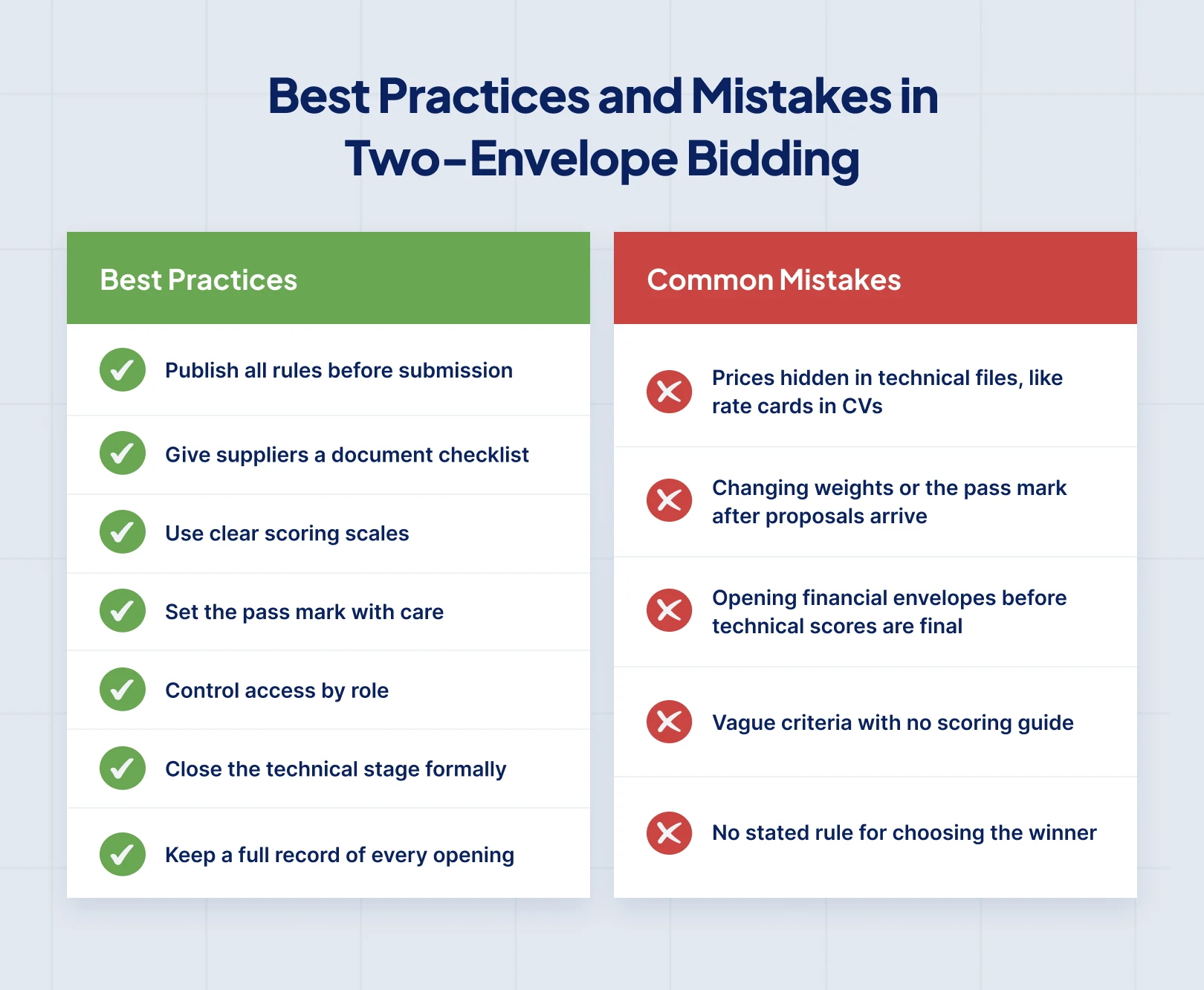
- Publish everything before submission. Envelope contents, criteria and weights, the minimum technical score, the selection method, deadlines, and the opening sequence all belong in the RFP. Suppliers write better proposals when they know how they will be judged.
- Give suppliers a document checklist. Say which files go in each envelope and state that pricing in technical documents may lead to disqualification.
- Use clear scoring scales. Define what each score means, for example 0 = not addressed, 5 = fully meets, 10 = exceeds, so evaluators score consistently.
- Set the pass mark with care. Too high and you may be left with one qualified supplier; too low and it filters nothing.
- Control access by role. Technical evaluators see technical material only. Check that prices cannot appear in attachments, reports, exports, or email notifications.
- Close the technical stage formally. Record final technical scores and the qualification decision, and get any required sign-off before financial envelopes are opened.
- Keep a full record. Log submission times, clarifications, scores, qualification decisions, who opened each envelope and when, and the final approval.
Common mistakes
- Prices hidden in technical files, such as rate cards in CVs or cost tables in a methodology section.
- Changing weights or the threshold after proposals arrive.
- Opening financial envelopes before every technical score is final.
- Using vague criteria like “quality of approach” with no scoring guide, which leads to inconsistent scores.
- Treating “two envelopes” as a selection method and forgetting to say how the winner will be chosen.
Running Two-Envelope RFPs Online
Running two envelopes over email and shared folders is where price leaks happen: a spreadsheet in a shared folder cannot truly seal a price. An eSourcing tool can keep the two parts apart and record who did what.
Two-envelope RFPs in WorkFish
In WorkFish RFP, you choose the bid type on the first step of creating an RFP: Open, Sealed until deadline, or Two-envelope. With two-envelope, technical answers open at the deadline, and prices stay sealed until technical scoring is submitted.
- Weighted scoring. Set the technical vs commercial split and section weights when you create the RFP.
- Pass mark. Define a minimum technical score. Only qualifying suppliers have their prices opened; the others are marked “Did not pass technical.”
- Approval control. If your workflow includes approvals, the commercial envelope stays sealed until the technical evaluation is approved.
- Normalized scores. Each supplier gets a 0–100 technical, commercial, and total score for ranking.
- Sealed, but manageable. Prices are hidden, participation is not. You can still track invitations, approve NDAs, check terms acceptance, and answer questions through announcements.
- Audit trail. Every envelope opening is logged.
See two-envelope evaluation in action →
