RFI vs RFP vs RFQ at a Glance
An RFI (request for information) asks suppliers to tell you who they are and what they can do. An RFP (request for proposal) asks them to propose a solution and a price for a problem you've described, while an RFQ (request for quotation) asks for prices on something you've already defined precisely.
In practice, many buyers use the three in sequence: an RFI to find capable suppliers, an RFP to compare their approaches, and an RFQ to get firm prices. This guide explains what each document is, when to use it, how they differ, and how to run them when your purchasing spans several companies or sites.
What is an RFI (Request For Information)?
An RFI is a document a buyer sends to potential suppliers to gather information about their capabilities before deciding how, or whether, to buy. It's a research step: no prices are binding and no contract follows directly from it.
Public buyers treat it the same way. The US Federal Acquisition Regulation lists formal requests for information as one of the standard market research techniques used before a requirement is fixed.
Use an RFI when:
- You're buying something new and don't know what the market offers.
- You want to build or refresh a supplier shortlist.
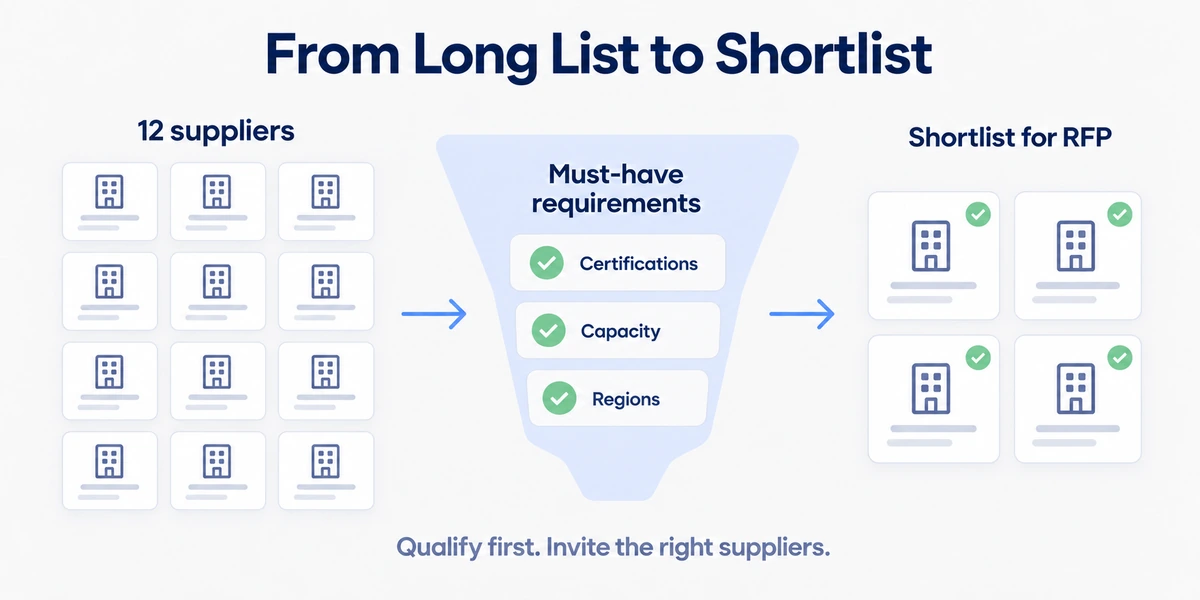
- You need to check whether suppliers meet basic requirements (certifications, capacity, regions served) before inviting them to a proposal.
Keeping a pipeline of alternative suppliers is also a resilience move. In Deloitte's 2025 Chief Procurement Officer Survey, maintaining active alternative sources was the most-cited strategy for reducing supply risk, named by 74% of procurement leaders.
Example RFI questions:
- Which products or services in this category do you supply, and to which regions?
- What production or service capacity can you commit per month?
- Which quality, safety or environmental certifications do you hold?
- Who are two comparable customers we could speak to?
- What are your standard lead times and minimum order quantities?
A well-structured questionnaire makes responses comparable side by side, which is where RFI software helps.
What is an RFP (Request For Proposal)?
An RFP is a document that describes a business need and asks suppliers to propose how they would meet it, and at what price. Unlike an RFQ, it leaves room for suppliers to suggest the solution, so you compare approaches as well as numbers.
The Government of Canada's procurement guidance describes an RFP as a call for bids that sets out the requirement and the criteria used to evaluate them, with the winning bid leading to a contract. Private companies use the same structure with fewer formal rules.
Use an RFP when:
- The need is complex: software, logistics services, maintenance contracts, packaging redesign.
- Quality, experience and approach matter as much as price.
- You expect suppliers to know better than you how to solve the problem.
What a good RFP includes:
- Purpose, objectives, and what is in and out of scope.
- A timeline: question deadline, response deadline, demos, decision date.
- A questionnaire grouped by theme (technical, implementation, compliance, service).
- A pricing table suppliers fill in, in one currency.
- Evaluation criteria and their weights, decided before responses arrive.
- Terms and, where needed, an NDA.
How proposals are scored. Each question gets a maximum number of points and a weight. A common approach is to normalize each score (points ÷ maximum points) and multiply it by the weight, so long free-text answers and yes/no answers count fairly. Agree the weights internally before you open any proposal. Some buyers also evaluate technical and price envelopes separately, a method known as two-envelope bidding.
Using RFP software keeps questionnaires, weights and scores in one place, so every evaluator works from the same sheet.
What is an RFQ (Request For Quotation)?
An RFQ is a request for prices on goods or services you have already specified: exact items, quantities, quality requirements and delivery terms. Because every supplier quotes on the same specification, the responses are directly comparable.
Use an RFQ when:
- You know exactly what you need (spare parts, packaging, raw materials, freight lanes).
- Price, lead time and payment terms are the main differences between suppliers.
- You buy the item repeatedly and want to re-test the market.
What an RFQ includes: line items with descriptions and quantities, the currency, delivery location and date, the response deadline, and any required supplier fields such as lead time, validity of the quote or payment terms.
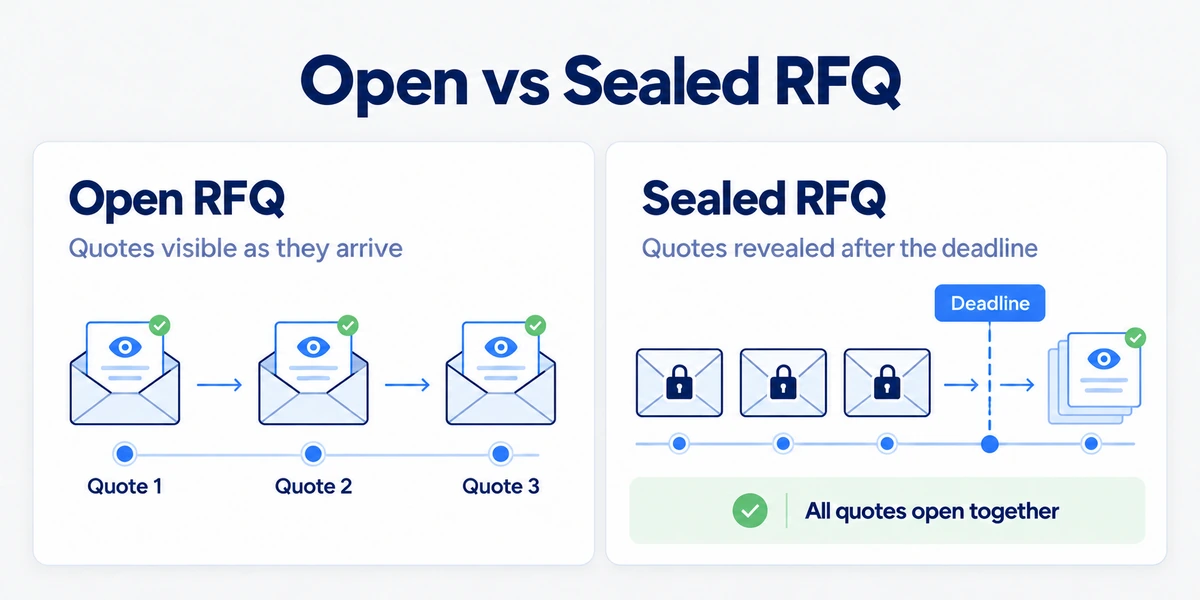
Open or sealed? In an open RFQ, the buyer can see quotes as they arrive. In a sealed RFQ, quotes stay closed until the deadline, so no one can adjust a price after seeing a competitor's. Sealed quotes take more discipline but give suppliers more confidence that the process is fair.
With RFQ software, quotes land in one comparison table, line by line, instead of in separate email attachments.
RFI vs RFP: The Key Difference
An RFI gathers information; an RFP asks for a commitment. The RFI tells you which suppliers are worth talking to, while the RFP asks those suppliers to put a concrete solution and price on the table, which you then score.
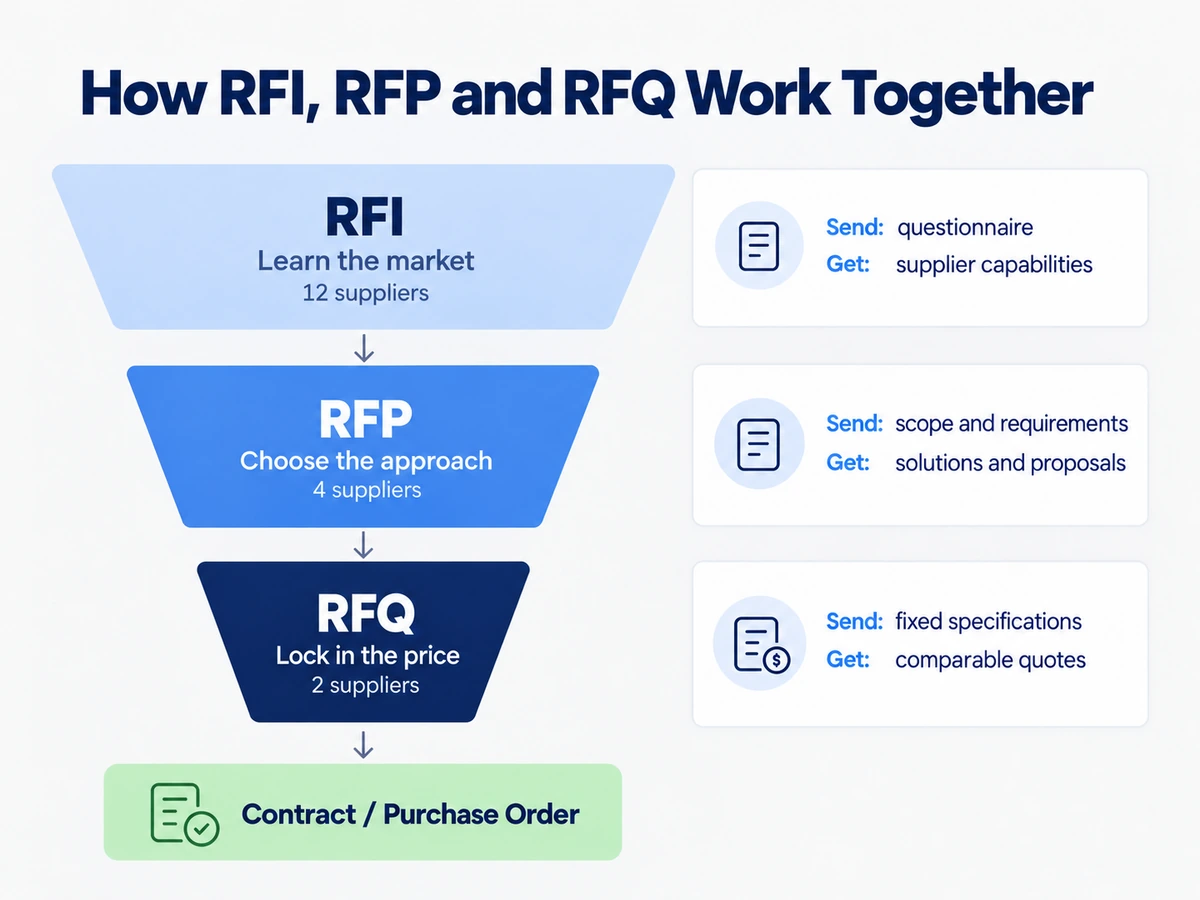
Example: a distributor wants to outsource warehouse operations in a new region. An RFI to twelve logistics providers reveals which ones operate there and have the right certifications. The four strongest receive an RFP describing volumes, service levels and reporting needs, and propose how they'd run it.
RFP vs RFQ: The Key Difference
An RFP asks "how would you do this?"; an RFQ asks "how much will this cost?". Use an RFP when the solution is open and quality must be judged; use an RFQ when the specification is fixed and suppliers compete mainly on price, lead time and terms.
Example: a manufacturer choosing a new packaging design runs an RFP, because suppliers propose materials and designs. Once the design is approved, the recurring purchase of that packaging is re-quoted through an RFQ to approved suppliers, for example every quarter.
How RFI, RFP and RFQ Work Together
The three documents form a funnel: each step narrows the field and makes the requirement more precise.
- RFI: a broad list of suppliers answers a short questionnaire. You shortlist those who meet your basic requirements.
- RFP: the shortlist proposes solutions and prices. You score them against weights agreed in advance and pick one or two.
- RFQ: with the solution fixed, you request firm quotes, compare them line by line, and award.
You don't always need all three. Skip the RFI when you already know the qualified suppliers. Skip the RFP when the specification is standard and only price matters; go straight to an RFQ. For a new, complex category, the full sequence usually saves time later, because each step filters out suppliers who can't deliver.
If you're comparing tools to run this process, see how to choose RFQ software.
Running RFx Across Several Companies and Sites
When one group buys for several companies, plants or warehouses, the hard part is rarely the document itself. It's keeping every location on the same process while each keeps its own budgets, owners and approvers. In Deloitte's 2025 CPO Survey, procurement leaders named siloed ways of working as the top barrier to delivering value (57%).
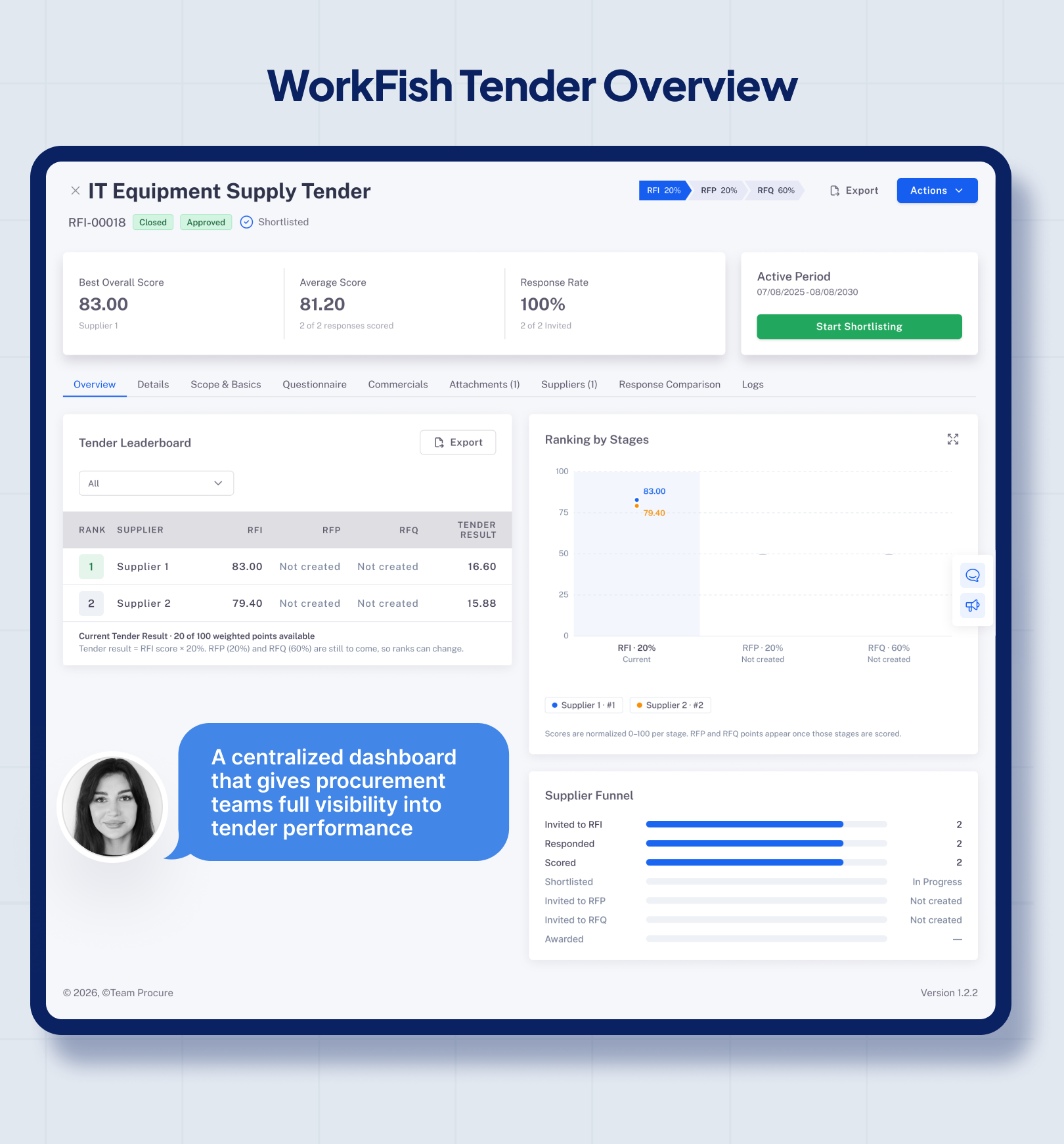
Here's how that looks in WorkFish. A category manager runs an RFI to a broad supplier list using questions from a shared company library, so every site asks suppliers the same things. Responses are compared side by side, and the best suppliers are shortlisted. The shortlist then receives an RFP that is tied to a specific location, department, project and budget, with a scored questionnaire and a pricing table in one currency. Evaluators score answers manually or automatically against weights set in advance, while colleagues from other sites can follow as observers without editing anything.
Suppliers come from the existing supplier database, can be invited for the first time, or imported in bulk. Terms and NDAs are applied before suppliers can respond, and invitations and deadline reminders go out automatically, with translated versions where you set them up. Every setup can be saved as a template, so the next site starts from the same setup instead of rebuilding it. When the solution is settled, the RFQ collects line-by-line quotes in one comparison table.
Run RFI, RFP and RFQ In One Flow
Use RFIs to learn the market, RFPs to choose an approach, and RFQs to lock in price. WorkFish keeps all three in one place, across all your companies and sites.