
Procurement problems rarely begin with the purchase order. They usually surface earlier - when supplier data lives in scattered spreadsheets, contracts sit disconnected from daily buying workflows, teams place requests without visibility into approved terms, or strong sourcing outcomes fail to reach operational purchasing. By the time the purchase order appears, control has often already slipped away: the chosen supplier may not be preferred, pricing may deviate from negotiated agreements, approvals stall for lack of context, and finance sees the full commitment only when the invoice arrives.
Source-to-Pay (S2P) directly addresses this disconnect. It unifies the entire procurement lifecycle into one connected operating model. Rather than treating each step as an isolated administrative task, S2P creates seamless flow where upstream decisions naturally guide downstream execution. For WorkFish this means procurement moves beyond simple buying to deliver genuine control, consistency, and value across every decision, document, approval, and supplier relationship that shapes business spending.
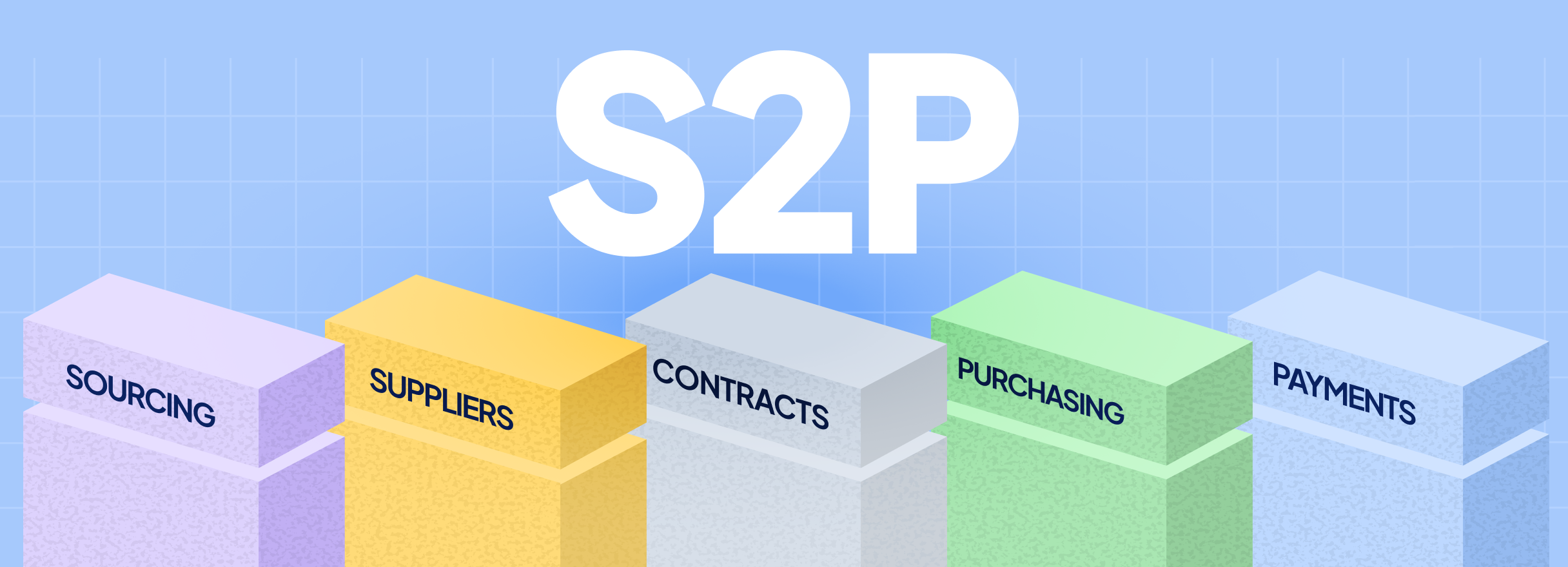
S2P represents the complete end-to-end procurement process that connects strategic sourcing decisions with operational purchasing and payment execution. At its core, S2P encompasses every major step:
In straightforward terms, S2P creates a seamless bridge between how an organization selects and contracts with suppliers and how it actually buys from them on a daily basis. Rather than operating in separate silos, the process ensures that negotiated terms, preferred suppliers, and approved conditions flow naturally into purchasing workflows. This connection prevents common breakdowns such as off-contract spending, duplicate suppliers, or purchases made without proper context.
Procurement terminology often creates confusion because the terms overlap in practice, yet each model covers a distinct portion of the overall lifecycle. Understanding the differences helps organizations select the right approach based on their maturity and specific challenges.
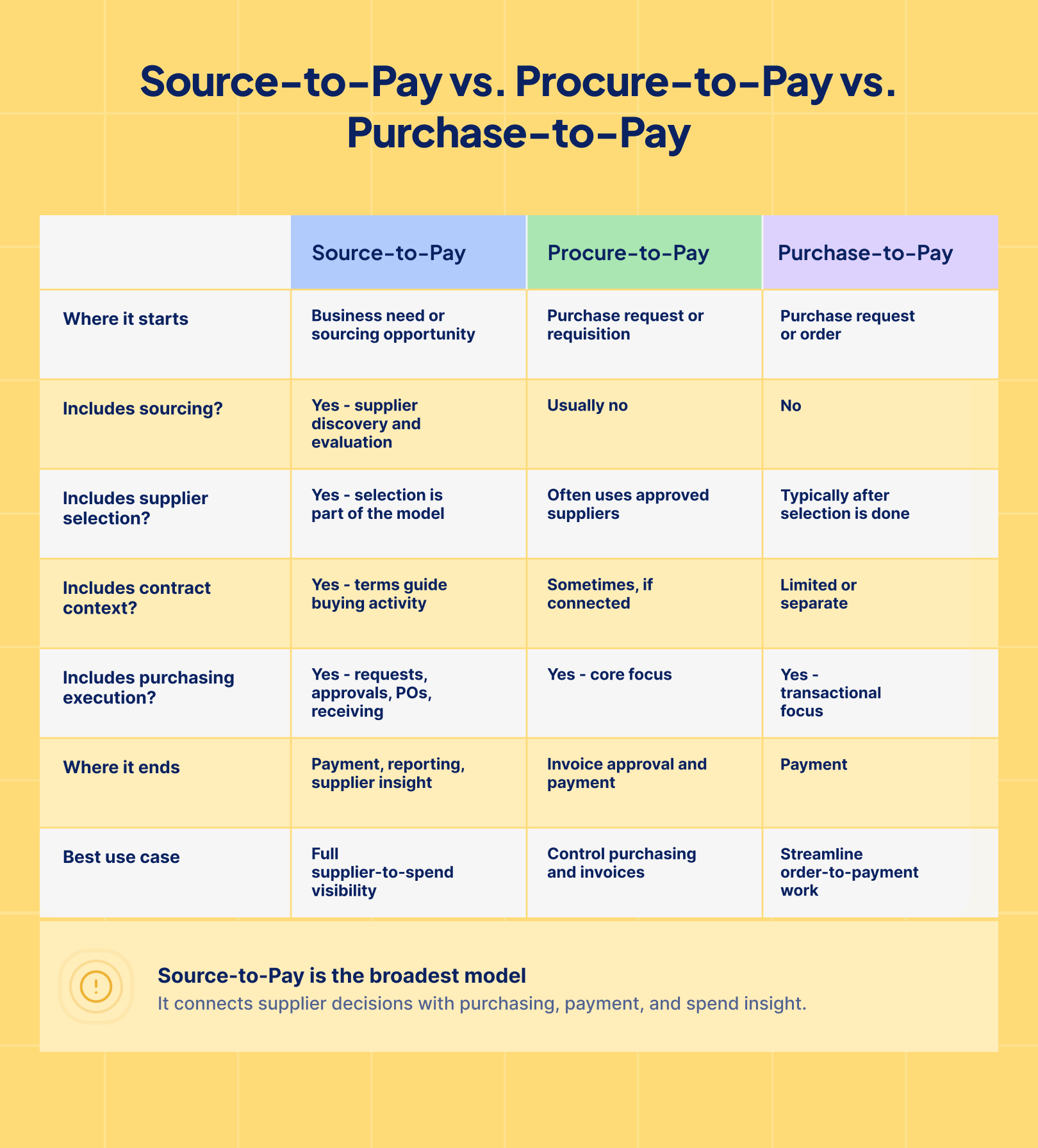
Source-to-pay is the broadest of the three. It covers the full lifecycle from sourcing and supplier selection through purchasing, receiving, invoice matching, payment, and spend analysis.
Procure-to-pay, or P2P, usually focuses on the purchasing execution process. It often starts when a user requests something and continues through purchase approval, purchase order creation, receiving, invoice approval, and payment.
Purchase-to-pay is often used similarly to procure-to-pay, though in some organizations it is narrower and more transaction-focused. It typically emphasizes the path from purchase request or purchase order to invoice and payment.
Under a pure Purchase-to-Pay approach, the team might quickly issue a purchase order to a familiar vendor and process the invoice once goods arrive. This works for routine, low-value items but risks paying higher prices or working with suboptimal suppliers.
With Procure-to-Pay, the process adds structured requisitioning, budget checks, and three-way matching for accuracy and compliance. It improves efficiency in daily transactions and reduces errors, yet still relies on existing approved suppliers and contracts.
S2P extends further upstream, The team would first conduct a sourcing event (RFQ or RFP), evaluate multiple suppliers on price, quality, delivery reliability, and risk, negotiate favorable contract terms, and only then allow purchasing activity to proceed under those agreed conditions. This ensures the company captures negotiated savings, maintains compliance, and builds stronger supplier relationships over time.
A company can optimize its procure-to-pay or purchase-to-pay processes and still suffer from weak overall procurement performance. For instance, fast invoice processing offers little value if the organization consistently buys from non-preferred suppliers at above-market rates due to disconnected sourcing decisions.
S2P addresses this by creating a single connected operating model. It prevents maverick spend, reduces duplicate suppliers, enforces contract compliance, and feeds real-time performance data back into future sourcing activities.
For many mid-sized and operationally complex businesses, WorkFish make this full S2P model practical by unifying sourcing, contracts, purchasing, and analytics in one environment - turning procurement from a series of separate tasks into a cohesive driver of control and value.
In short, P2P and Purchase-to-Pay deliver important operational efficiency, while S2P provides the strategic foundation that turns procurement into a genuine competitive advantage.
This integrated approach delivers significant advantages. It transforms procurement from fragmented administrative tasks into a cohesive operating model that maintains control across the full lifecycle.
The goal is not just to digitize procurement paperwork. The goal is to create a connected workflow where supplier decisions, purchasing activity, and financial control all support each other.
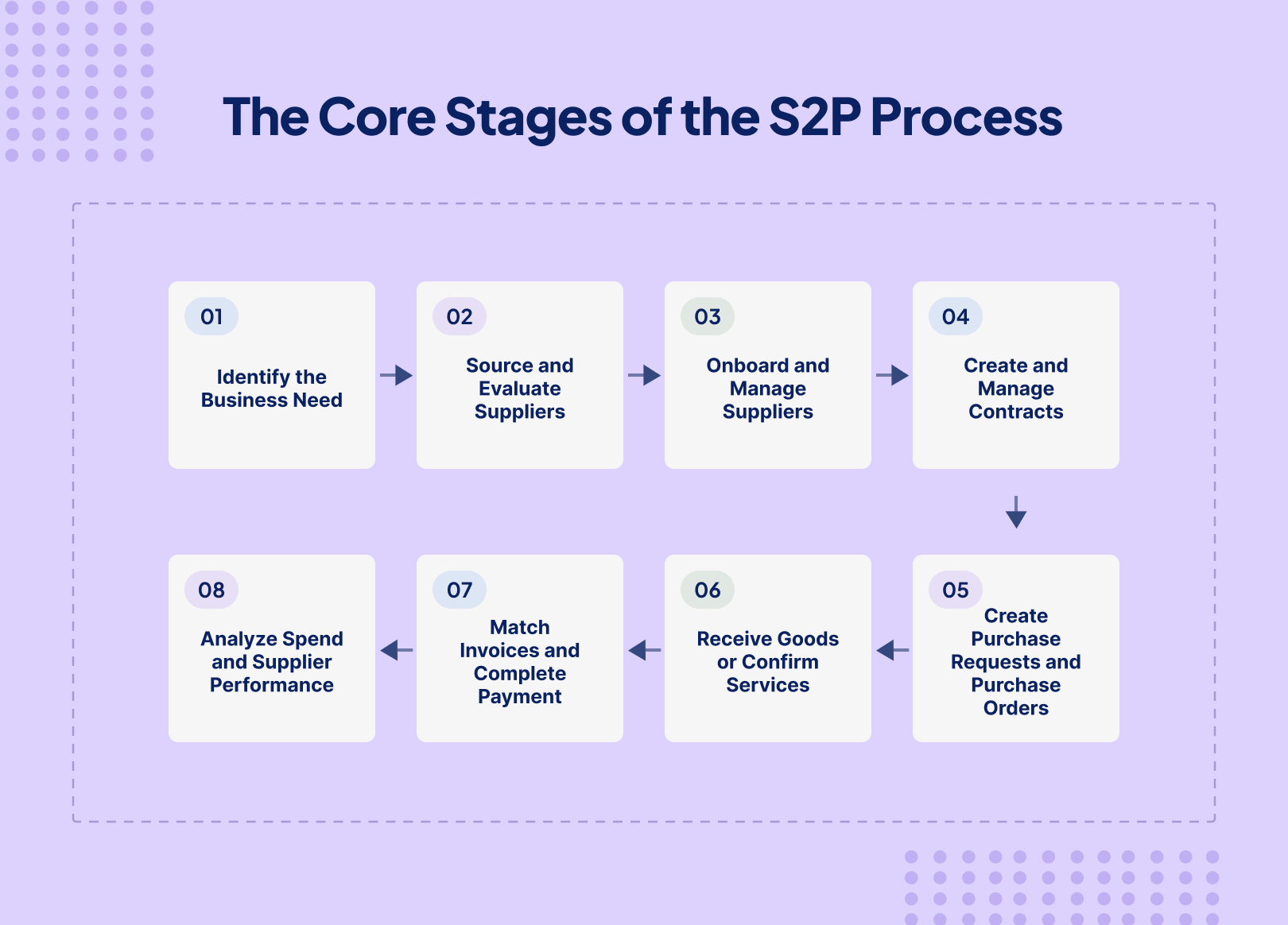
The S2P process follows a logical, connected sequence that varies slightly by industry and organization size, but most implementations include these core stages:
The process begins when the business identifies a need. That need may be a recurring material, a project-specific purchase, a service requirement, a replacement part, an inventory item, or a new supplier category.

Once a supplier is selected, the organization needs to maintain accurate supplier information. This can include contacts, locations, tax information, insurance documents, compliance records, product or service categories, pricing agreements, payment terms, and performance history.
Contracts define the commercial terms behind supplier relationships. They may include pricing, delivery expectations, service levels, renewal dates, payment terms, compliance requirements, and termination conditions.
When a team needs to buy, the request should move through a structured workflow. That may include budget checks, manager approvals, procurement review, supplier selection, and purchase order creation.
After the purchase order is issued, the business needs to confirm whether goods were delivered or services were completed.
Invoice matching compares the supplier invoice against the purchase order and receiving record. This helps confirm whether the invoice reflects what was approved and delivered.
Invoice matching compares the supplier invoice against the purchase order and receiving record. This helps confirm whether the invoice reflects what was approved and delivered.
S2P becomes valuable when procurement is too complex to manage through disconnected tools and informal processes. The problems are often practical, not theoretical.
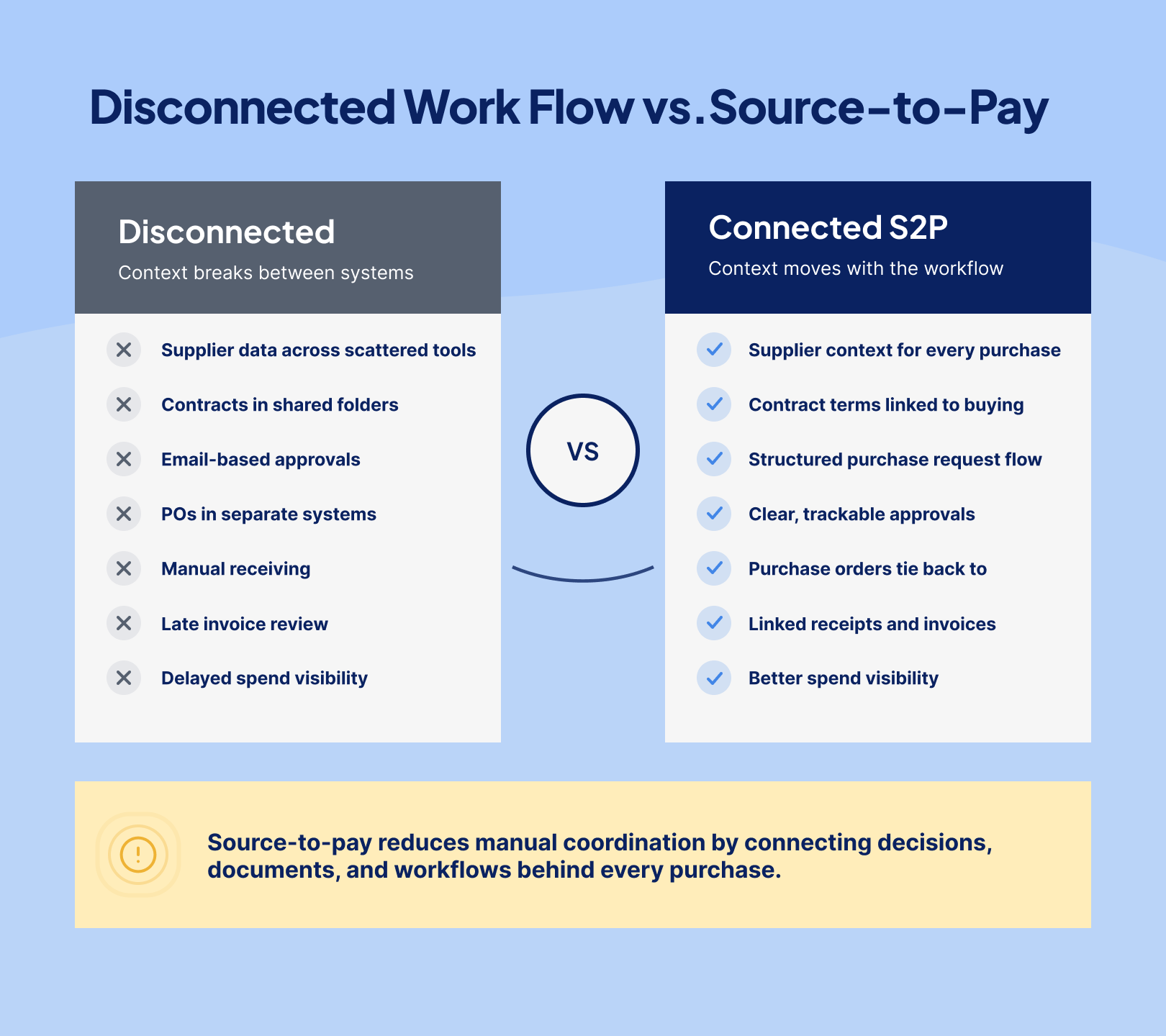
Supplier data often lives in spreadsheets, emails, and separate systems, leading to duplicates, outdated records, and inconsistent decisions. A procurement team might, for instance, engage the same vendor multiple times under slightly different names or overlook key compliance documents.
WorkFish solves this with a centralized supplier management system and a dedicated supplier portal. All critical information resides in one accurate, real-time repository accessible to authorized teams across the organization.
Strongly negotiated contracts frequently remain disconnected from daily purchasing activity, resulting in off-contract spending and unrealized savings. For example, a sourcing team may secure favorable pricing only for operations to continue buying at higher rates from unapproved sources.
WorkFish directly connects sourcing awards and contracts to purchasing workflows. Negotiated terms automatically guide supplier selection, purchase order creation, and approval rules, ensuring that buying activity consistently respects agreed-upon conditions and captures the full value of sourcing efforts.
Manual, email-based, or poorly structured approval processes create bottlenecks that delay critical purchases and frustrate internal teams. In fast-moving environments, urgent requests often stall while teams hunt for missing context or chase approvers.
WorkFish’s no-code workflow automation engine enables procurement teams to design intelligent, conditional approval routes based on amount, department, location, category, or other business rules. Full context travels with each request, mobile access keeps processes moving, and automation significantly accelerates cycle times while maintaining control.
Finance teams often gain visibility into commitments only after invoices arrive, making it difficult to manage cash flow, track budgets, or prevent unexpected liabilities. This lag leaves leadership reacting to problems rather than preventing them.
WorkFish provides real-time spend visibility across the entire S2P lifecycle. As purchase requests and orders are created, commitments become immediately visible to finance, enabling proactive budget control, accurate forecasting, and early identification of potential issues.
Without connected data, evaluating supplier reliability, quality, and value becomes subjective and time-consuming. Organizations struggle to identify top performers or address underperformance systematically.
WorkFish integrates supplier performance tracking directly into the platform. Automated metrics such as on-time delivery, quality compliance, and responsiveness feed into dashboards and reports. These insights support data-driven supplier reviews, improvement plans, and smarter sourcing decisions in future cycles.
By resolving these interconnected challenges within a single, cohesive environment, WorkFish helps medium-sized and operationally complex organizations turn procurement into a reliable source of control, efficiency, and strategic value.
WorkFish is purpose-built to break down the traditional silos that fragment procurement. By uniting sourcing, supplier management, contracts, and purchasing into one intelligent, connected platform, it creates seamless information flow where upstream decisions automatically strengthen and guide downstream execution.
This unified approach ensures negotiated terms flow naturally into daily purchasing, supplier performance informs future sourcing, and the entire process operates as a single, cohesive system — delivering greater control, compliance, and value for medium-sized and operationally complex organizations.
For example, a category manager completes a sourcing initiative for packaging materials and awards the business to a preferred supplier with specific volume pricing. In Workfish, this award instantly updates the supplier record, generates or updates the associated contract, and makes the supplier and pricing available for purchase requests across relevant departments. Buyers see only approved options, with contract terms clearly visible during requisitioning.
Better supplier visibility
More controlled purchasing
Stronger contract compliance
Improved supplier performance insight
Earlier spend visibility
Cleaner invoice context
Better budget control
More reliable approval trail
Faster request handling
Clearer order status
Better supplier context
Less manual follow-up
Source-to-pay is more than a procurement term. It is a connected way to manage the full lifecycle of supplier decisions and purchasing execution. The main lesson is simple: companies lose control when sourcing, supplier data, contracts, purchasing, receiving, invoices, and spend reporting live in separate places.
A strong S2P process helps teams choose suppliers more deliberately, connect contract terms to purchasing activity, manage purchase requests and approvals more clearly, track purchase orders and receiving, support invoice matching, and improve spend visibility over time. WorkFish helps teams connect these workflows so procurement becomes more visible, controlled, and operationally useful.
Procurement rarely fails at the purchase order — it fails earlier when sourcing, supplier data, contracts, and daily buying operate in disconnected silos. This fragmentation leads to lost savings, off-contract spending, poor visibility, and unnecessary risk. Source-to-Pay (S2P) solves this by unifying the entire procurement lifecycle into one seamless operating model, ensuring that strategic sourcing decisions and negotiated terms naturally guide operational purchasing and payment.
For mid-sized and operationally complex organizations, WorkFish makes true Source-to-Pay practical and effective. By connecting sourcing, supplier management, contracts, purchasing, and analytics in one intuitive platform, it delivers real-time visibility, stronger compliance, and continuous improvement. The result is procurement that moves beyond administrative tasks to become a genuine source of control, efficiency, and competitive advantage.